How to Patch a Hole in Plasterboard
21 August 2026 Joe HartleyBeginner1–3 hours (plus drying)16 comments
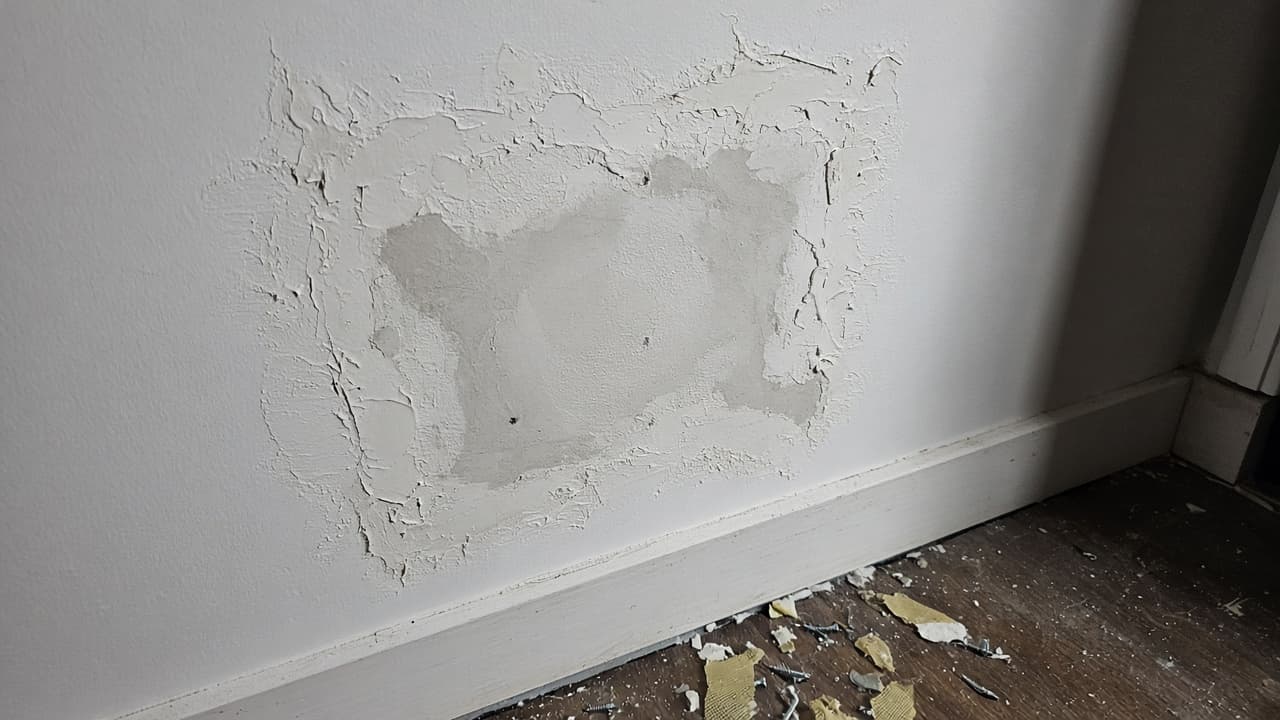
Tools
- Pad saw or jab saw
- Drill and plasterboard screws
- Filling knife
- Spirit level or straight edge
- Sandpaper (120–180 grit)
A doorknob dent or a vanished wall fixing leaves a hole that filler alone cannot bridge. Plasterboard needs something behind it: a timber backer, a mesh patch plate, or a cut-in board square. Get the support right and the face fills like any other shallow repair.
If the plaster is solid and hollow over brick, that is blown plaster, not board: how to repair blown plaster. A large void in an old plaster-on-masonry wall sits in how to repair a large hole in a plaster wall.
Choose the patch method
| Hole size | Method |
|---|---|
| Up to about 25 mm (rawlplug blow-out) | Filler alone, pressed well in |
| Roughly 25–75 mm | Self-adhesive mesh patch plate, then filler |
| Larger than a fist, up to about 300 mm | Timber backer behind, plasterboard offcut screwed on |
| Whole panel damaged or soft from damp | Replace the board section; see boarding guides in this cluster |
UK plasterboard is commonly 9.5 mm or 12.5 mm. Match the thickness so the face sits flush. Standard boards are not for wet rooms; use the right board type if you are in a bathroom.
Before you cut, check for cables with a detector and treat the void as live if you are near sockets or switches. Isolate power if you must work beside electrical points.
What you will need
| Item | Notes |
|---|---|
| Plasterboard offcut | Same thickness as the wall |
| Softwood offcuts | Backer battens, roughly 50 × 25 mm works well |
| Plasterboard screws | Fine thread; do not crush the paper face |
| Mesh joint tape or patch plate | Bridges joints and small holes |
| Setting or ready-mixed filler | Or jointing compound for board |
| PVA (optional) | Dusty cut edges only, thinly |
Step-by-step
1. Square up the damaged area
Draw a neat rectangle around the hole. Cut out the damaged board with a pad saw. Keep the cut just large enough to reach sound board all round. Vacuum dust from the cavity so nothing rattles later.
2. Fit a backer (larger holes)
Feed a timber offcut into the cavity, spanning beyond the hole on two opposite sides. Hold it tight to the back of the existing board and fix through the sound board into the timber with plasterboard screws. You now have a solid landing for the patch. For small holes, skip timber and stick on a mesh repair plate centred over the opening instead.
3. Cut and fix the patch
Cut a plasterboard piece to fit the opening with a tight but comfortable gap (a couple of millimetres is fine). Screw it to the backer. Countersink screw heads just below the paper face without tearing it. On mesh plates, follow the pack: press firmly so the adhesive grips clean, painted board (degloss shiny paint lightly first).
4. Tape and fill
Bed mesh tape over the joints of a board patch. Fill screw heads and joints with a thin coat of filler or jointing compound. Let it set, then a second wider, thinner coat to hide the edges. For a mesh plate, push filler through the mesh into the void, then skim over the plate until flat.
5. Sand and skim if needed
Sand lightly when hard. If the repair still reads under a raking light, a thin local skim finishes it: how to skim a wall patch. Spot-prime bare filler before the final emulsion so the patch does not flash.
Mistakes that leave a soft spot
- Filling a large hole with no backer so the filler falls into the cavity.
- Using coarse wood screws that tear the board face.
- Leaving the patch proud or recessed because the board thickness did not match.
- Skipping tape on board joints so a hairline appears after painting.
- Working over damp or mouldy board instead of cutting back to dry material.
When to call a plasterer or electrician
Call help if the cavity hides damaged cables, if a large area of board is soft from leaks, or if you need to reboard a full wall onto masonry (hang plasterboard on a solid wall). Recurring damp stains on cold external walls need moisture control, not endless patches: condensation stains on cold walls.
Related: fill cracks in plaster for surface cracks once the board is sound.
FAQ
Do I need a timber backer or will a mesh plate do?
Mesh plates suit holes up to roughly fist size. Larger openings need a timber backer and a cut plasterboard square so the face does not flex under the filler.
Can I use a ready-made patch kit?
Yes for smaller holes. Mesh plates with filler work well up to roughly fist size. Bigger openings are more reliable with a timber backer and a cut plasterboard square.
Why does the patch crack after painting?
Usually no tape on the joint, a patch that can flex because the backer is loose, or filler applied too thick in one go. Refix any movement, retape, and refill in thinner layers.
16 comments