How to Find Your Stopcock in a UK Home
17 July 2026 Joe HartleyBeginner10–30 minutes13 comments
Tools
- Torch
- Adjustable spanner (if the handle is seized)
- Pen and label for marking the valve
You need the stopcock before a pipe bursts, not during it. In most UK homes the internal stopcock is a gate valve or lever valve on the rising main, often hidden in a dusty cupboard. Find it once, label it, and try a quarter-turn or a gentle close so you know it moves when you are not standing in a puddle.
This guide is about locating and recognising the valve. Turning it off properly sits in how to isolate a water supply at the stopcock UK. Local isolation under a basin is different again: that is usually a small isolation valve on the flexible tap tails, which is what you use for most leaky tap jobs.
Stopcock vs isolation valve vs external meter key
| Control | What it is | Typical place |
|---|---|---|
| Internal stopcock | Whole-house (or whole-flat) shut-off on the rising main | Under kitchen sink, utility, under stairs, cellar, airing cupboard pipe run |
| Isolation / service valve | Shuts one tap, toilet, or appliance | On the copper or flexi under the fitting |
| External stopcock / meter | Water company side; often needs a key | Footpath, drive edge, or meter chamber outside |
Do not assume the shiny under-sink lever is the mains stopcock. Many kitchens have isolators on hot and cold tails plus a separate mains valve deeper in the cupboard or elsewhere in the house.
Where UK homes usually hide it
Work through these in order with a torch:
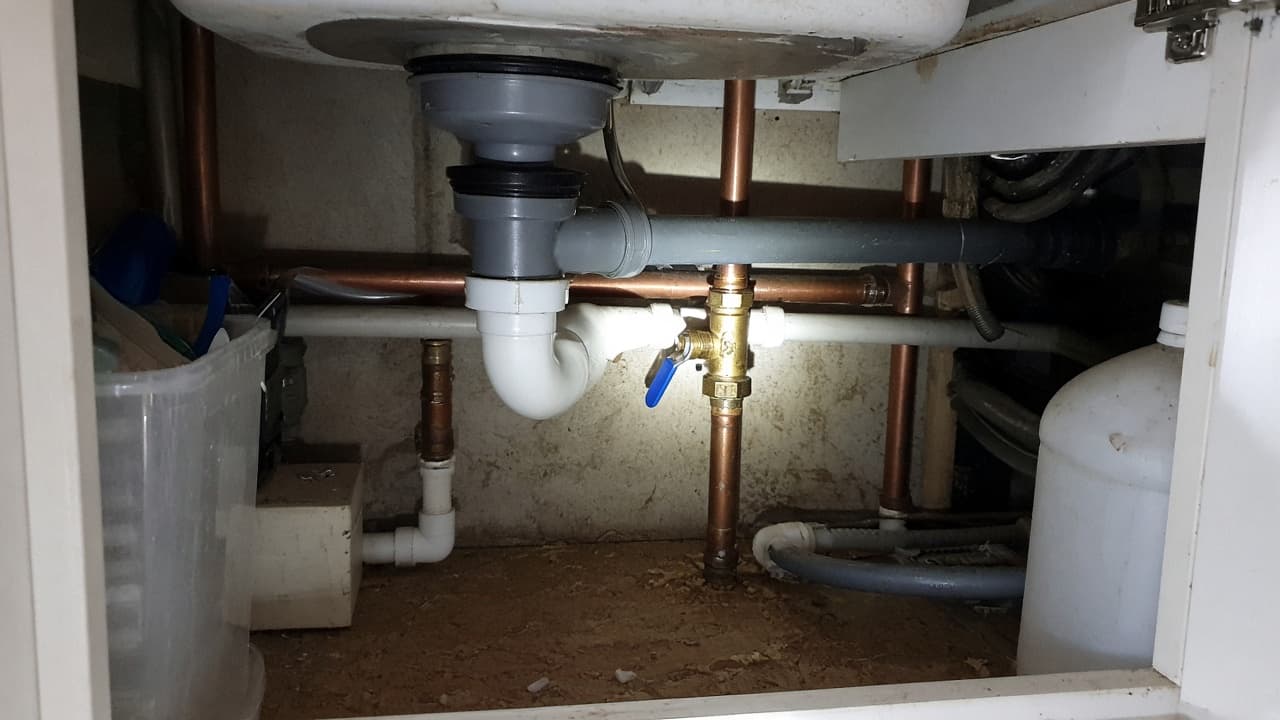
- Kitchen sink cupboard: Look at the back and sides for a larger valve on a copper pipe rising from the floor or coming through the wall. Older homes often have a brass gate valve with a criss-cross handle.
- Utility or cloakroom: Same idea if the kitchen was refitted and the rising main was boxed elsewhere.
- Under-stairs cupboard: Common in terraces where the main enters near the front door.
- Garage, cellar, or ground-floor meter cupboard: Newer builds sometimes put the internal stopcock beside the water meter inside a hall or garage cupboard.
- Bathroom or airing cupboard: Less common for the main stopcock, but check if other locations fail. You may only find tank and cylinder valves there on older indirect systems.
In flats, your stopcock may sit in a shared riser cupboard on the landing. Ask the freeholder or managing agent where the demise valve is before you shut off a neighbour’s supply by mistake.
Step-by-step
1. Follow the rising main from outside if you can
If you know where the external meter or boundary box sits, the internal pipe often enters on that same wall. Start searching cupboards along that line.
2. Identify the valve type
A gate valve has a round or cross head that winds closed over several turns. A lever ball valve has a handle in line with the pipe when open, and across the pipe when closed. Either can be the stopcock.
3. Confirm it is the mains, not a local isolator
Local isolators are usually small and sit close to a tap, washing machine, or toilet cistern. The stopcock sits on the larger incoming cold main before it branches. When in doubt, close the candidate valve and open a cold kitchen tap: if flow dies house-wide (or flat-wide), you have the right one.
4. Test gently and label it
Open a cold tap, then close the stopcock slowly. Gate valves can seize; do not lean a metre of scaffolding tube on the handle. If it will not budge, stop and get help rather than snapping the spindle. When it works, mark it with a luggage tag or permanent label: “Mains stopcock”.
5. Note the external stopcock for emergencies
Photograph the meter chamber location and keep a stopcock key if your external cover needs one. That chamber is often the water company’s responsibility; you may still use it in a serious leak if the internal valve fails.
Mistakes that waste the first ten minutes of a flood
- Searching only under the bathroom basin for a whole-house shut-off.
- Forcing a seized gate valve until the spindle shears.
- Shutting a shared landing valve in a block without knowing who else goes dry.
- Confusing the gas meter cupboard with the water meter cupboard.
- Never testing the valve, then discovering it is painted solid during a burst.
When to call a plumber or the water company
Call a plumber if you cannot find any internal stopcock, if the valve is seized or passes water when closed, or if you live in a flat with an unclear shared supply. Call your water company if the leak is on the supply side of the meter or you need the external stopcock operated or located. After you can isolate, return to the local job: how to fix a leaky tap, or replace a failed local valve via how to replace an isolation valve.
Full shut-off method once you have found it: how to isolate a water supply at the stopcock UK.
FAQ
Where is the stopcock in a UK house?
Most often under the kitchen sink, in a utility cupboard, under the stairs, or beside an internal meter cupboard where the mains enters. Follow the cold rising main from the external meter wall if the usual cupboards are empty.
What if I only find small valves under the sink?
Those are usually isolation valves for the taps or dishwasher. Keep looking for a larger valve on the incoming cold main. You can still use local isolators for a single leaky tap without shutting the whole house.
Can I use the outside stopcock instead?
In an emergency, yes if you can access it safely and it works. Day to day, learn the internal stopcock so you are not kneeling in the street at night. External fittings may be locked or need a company key.
13 comments