What Electrical Work Can You DIY in the UK
14 August 2026 Joe HartleyBeginnerReading time 8–12 minutes14 comments
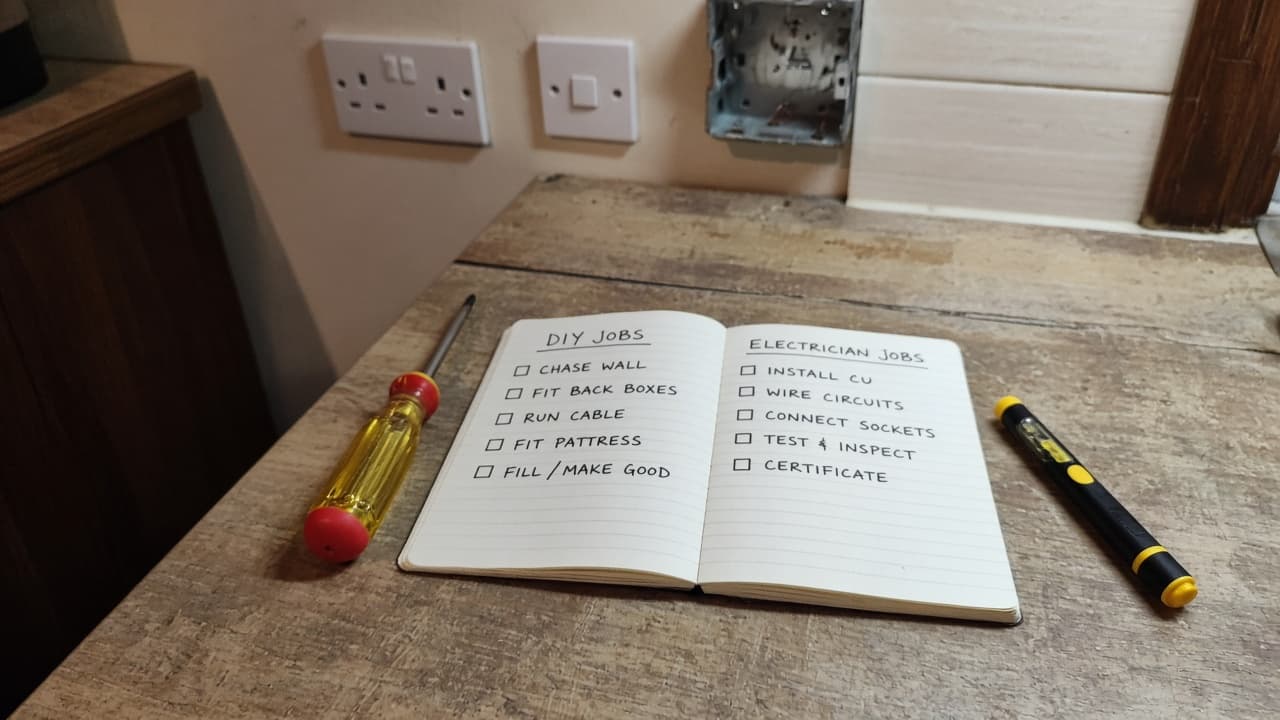
Tools
- Notebook for listing jobs and circuit labels
- Voltage tester (only if you attempt an allowed like-for-like swap)
- Torch for reading the consumer unit legend
Most electrical “DIY” arguments start with the wrong question. The useful one is not “Can I open a faceplate?” It is “Is this a like-for-like swap on an existing fitting, or am I changing the circuit?” In England and Wales, Building Regulations Part P draws that line. Scotland and Northern Ireland use different building-control routes, but the same practical rule holds: keep within simple replacements, or hire a registered electrician.
Read Part P explained for homeowners before you buy parts. This page is the quick decision table that sits beside it.
DIY versus electrician at a glance
| Job | Typical DIY? | Notes |
|---|---|---|
| Replace a light switch like-for-like | Often yes | Same switch type, same terminals used. Isolate at the consumer unit first. |
| Replace a two-way switch like-for-like | Often yes | Match COM / L1 / L2. Stop if the layout differs. |
| Replace a socket faceplate like-for-like | Often yes | Same single or double, same cable count into the same back box. |
| Change a cracked socket front only | Often yes | Still isolate; do not move the back box. |
| Swap a GU10 or bayonet lamp | Yes | Power off at the switch or isolate the lighting circuit if unsure. |
| Rewire a plug or change a plug fuse | Yes | Correct fuse rating for the appliance flex. |
| Reset a tripped RCD or MCB | Yes | If it will not stay reset, stop and investigate safely or call help. |
| Add a new socket or spur | No (as DIY) | Usually needs a competent person / notification. Not covered here. |
| Move a socket or switch to a new position | No | New cable routes and fixing points. Electrician job. |
| Fit a new circuit (kitchen, shower, outdoor) | No | Notifiable / registered work. Do not attempt from a how-to page. |
| Work inside the consumer unit | No | Busbars, RCDs, and main switches are not DIY. |
| Bathroom zone fittings and new bathroom circuits | Usually no | Zones and IP ratings matter. Prefer an electrician. |
| Outdoor socket or new outdoor lighting circuit | Usually no | Weatherproofing and RCD protection are not guesswork. |
“Often yes” still means: isolate properly, photograph the wiring, and stop the moment colours, conductor count, or terminal labels do not match the old fitting. Like-for-like is a replacement of the accessory, not a redesign of the circuit.
What “like-for-like” actually means
Like-for-like means the new accessory does the same job in the same place, on the same cables, into the same back box. A white plastic one-way switch can become a matching one-way switch (including a different finish). A single socket faceplate can become another single socket faceplate on the same cables. It does not mean upgrading a one-way switch to two-way, turning a single into a double by fishing new cable, or adding USB electronics that need different supply arrangements without checking the product and the existing circuit.
If you open a back box and find more conductors than the new faceplate has room for, or terminal markings that do not map cleanly, refit the old plate and call an electrician. Guessing terminal order is how DIY electrics go wrong.
Safe DIY paths on this site
These guides stay inside replacement-only scope:
- How to replace a light switch like-for-like
- How to replace a two-way light switch like-for-like
- How to replace a socket faceplate like-for-like
None of them walk through new circuits, consumer unit alterations, or relocating accessories. If your job is not on that short list, treat it as electrician territory until Part P explained for homeowners (and local building control rules) say otherwise.
How to decide in five minutes
- Write down the exact job in one sentence (for example: “cracked double socket faceplate in the hallway”).
- Check whether the fitting stays in the same hole, on the same cables, with the same function.
- If the answer is yes, read the matching like-for-like guide and isolate at the consumer unit before you undo screws.
- If the answer is no (extra socket, moved position, new light position, consumer unit work), book a registered electrician.
- In rented homes, check the tenancy and landlord rules as well. Permission and competence both matter.
A useful checkpoint at the consumer unit: if you cannot confidently identify and switch off the correct circuit breaker or fuse, you are not ready for a faceplate swap. Labelling is often incomplete in older houses. Do not isolate “the whole house” as a workaround and then poke live parts you have not verified dead.
Common mistakes on the DIY side of the line
- Treating “I have done plugs before” as permission to add a socket.
- Buying a smart or dimmer switch without checking whether the existing wiring and load suit it.
- Opening a metal faceplate job without an earth continuity plan, then leaving the earth loose.
- Ignoring old cable colours (red / black / green) and assuming modern brown / blue / green-and-yellow layout without checking.
- Working live because “it is only a switch.” Isolate, prove dead, then work.
When to call an electrician
Call a registered electrician for anything notifiable, anything that changes cable runs, anything in the consumer unit, and anything where the wiring behind a faceplate does not match a simple like-for-like map. Call one if breakers trip repeatedly, if sockets feel hot, if you smell burning plastic, or if you find scorched terminals. Those are fault findings, not weekend upgrades.
Also call help if you are unsure whether your nation or property type (England, Wales, Scotland, Northern Ireland, flat, rented) changes notification. Part P explained for homeowners covers the homeowner view; a local electrician or building control office covers the edge cases.
Related reading in this cluster: the three like-for-like guides above, plus Part P explained for homeowners for the regulation framing.
FAQ
Can I legally change a light switch myself in the UK?
In many cases a like-for-like switch replacement on an existing lighting circuit is treated as non-notifiable work in England, but you still need to work safely and competently. Isolate at the consumer unit, photograph the terminals, and stop if the new switch is not a direct match. Rules and notification routes differ by nation, so read Part P explained for homeowners and do not stretch “like-for-like” into a new circuit.
Is replacing a socket faceplate DIY or electrician work?
Replacing only the faceplate on the same back box, with the same cables landed the same way, is a common DIY-scope job when you can isolate and prove dead. Adding a socket, moving one, or altering the circuit is not. Use how to replace a socket faceplate like-for-like for the faceplate-only path.
What electrical work must I never DIY?
Do not DIY new circuits, consumer unit work, relocating accessories, or bathroom and outdoor installs that need design decisions around protection and zones. Do not “have a go” at anything where the wiring behind the plate does not match the old accessory clearly.
Does Part P ban all DIY electrics?
No. Part P (and related building standards) aim to keep fixed electrical installations safe. Simple replacements can sit on the DIY side when done properly. Changing the installation usually does not. See Part P explained for homeowners for the homeowner-facing split.
14 comments